Crime prevention through environmental design is the practice of shaping a place so that crime is harder to commit there. It works on sightlines, entrances, lighting, boundaries and upkeep rather than on locks and alarms alone.
The International CPTED Association describes it as “a multi-disciplinary approach to crime prevention that uses urban and architectural design and the management of built and natural environments.” The same source notes it is pronounced “sep-ted” and is also known as designing out crime or defensible space.
The idea is simple enough to state in a sentence. The value is in what it changes about how you look at a property.
What does CPTED actually mean?
It means treating the building itself as part of the security system. A corner that nobody can see into is a security problem even if a guard walks past it twice a night, because the problem is the corner.
Practitioners usually group the approach into four ideas. They overlap, and most real fixes touch more than one.
The four ideas
Natural surveillance
People behave differently when they can be seen. Natural surveillance means arranging a space so that normal activity puts eyes on it, without anyone being assigned to watch.
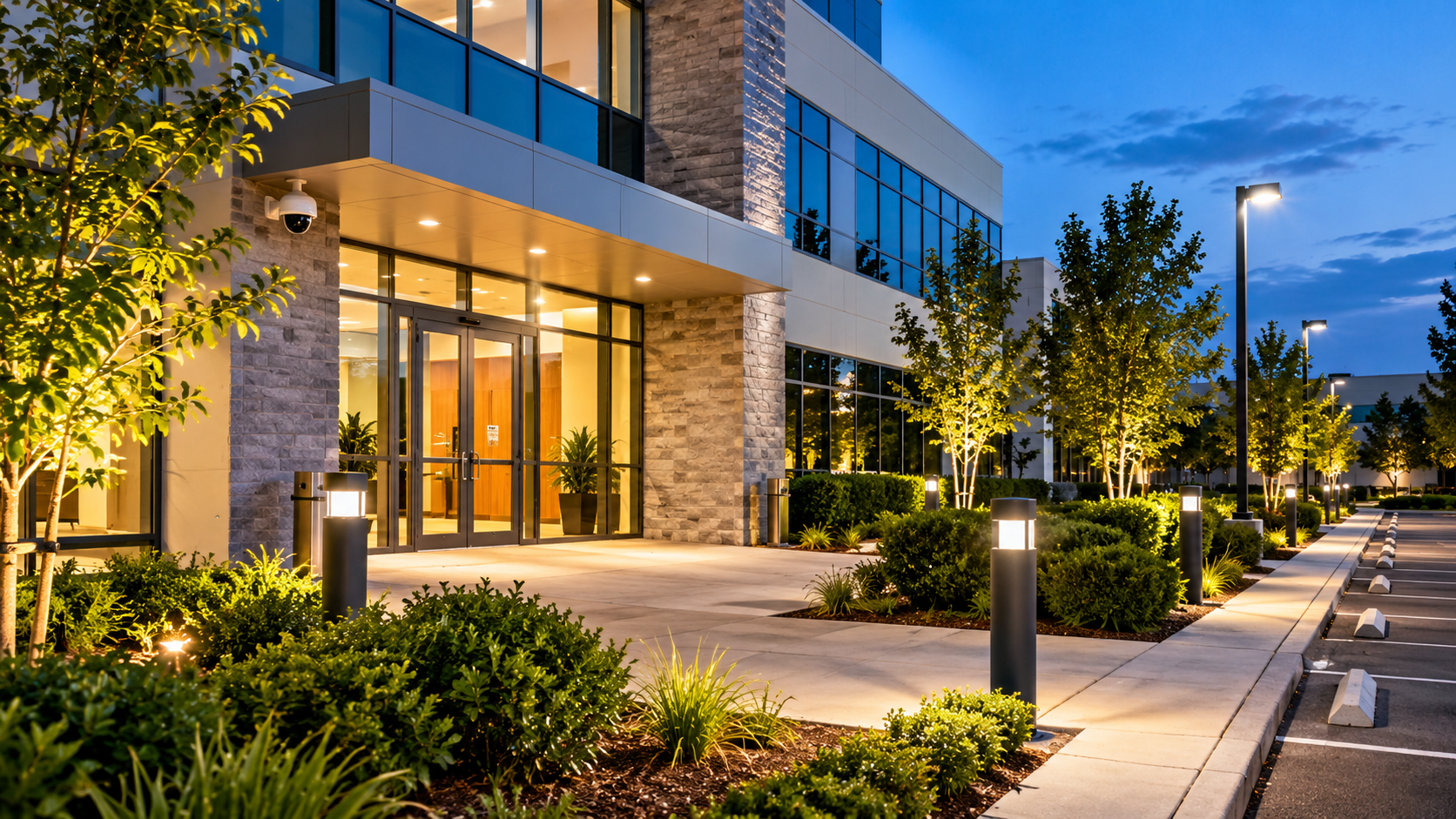
Low planting rather than high hedges near entrances. Lobbies with a view of the street. Stairwells with glazing instead of solid walls. Parking rows that face occupied windows.
The test is simple. Stand where someone would stand to do something they should not, and ask who can see them.
Natural access control
This is about guiding movement rather than blocking it. A single clear entrance tells a visitor where to go and tells everyone else that the side door is not the way in.
Paths, gates, planting, level changes and signage all steer people. Done well, a visitor never notices they were steered.
Territorial reinforcement
A space should look owned. Boundary markers, surface changes, signage and consistent branding all signal that someone is responsible for this ground.
The effect is on both sides. Legitimate users feel ownership. Anyone else loses the excuse that they wandered in by accident.
Maintenance
A property that looks cared for gets treated better. Broken lights, graffiti left up, overgrown planting and propped doors all read as neglect, and neglect invites more of it.
Maintenance is the cheapest of the four and the one most often dropped after year one.
Where does CPTED apply in a building?
Anywhere people arrive, wait, or pass through unobserved. In practice that means a short list that is worth walking with fresh eyes.
| Area | What to look at |
| Entrances | Is there one obvious way in? Can reception see it? |
| Lobby | Sightlines to the door, the lifts and the stairs |
| Stairwells | Glazing, lighting, whether they are used or dead space |
| Loading dock | Who can see it, and when is it unattended |
| Parking | Blind corners, pillar placement, pedestrian routes |
| Perimeter | Planting height, boundary definition, lighting overlap |
| Back of house | Propped doors, bin stores, service corridors |
CPTED and target hardening are not the same thing
Target hardening is the reflex response: more locks, more fences, more shutters. It works, and it has a cost beyond the invoice.
A hardened building reads as a place where bad things happen. Shutters and razor wire signal risk to legitimate users as loudly as they signal it to anyone else, and they tend to push a problem to the next weak point rather than remove it.
The environmental design approach asks a different question first. Not how do we make this harder to get through, but why is this the point someone would choose.
Sometimes the answer still turns out to be a stronger door. More often it is a sightline, a light, a boundary that was never defined, or a route that puts people somewhere they should not be walking.
Three common mistakes
Treating it as a one-time exercise- Planting grows, lamps fail, and a layout changes the first time a tenant reconfigures. An assessment describes a property on one day.
Lighting everything brightly- Uniformity matters more than brightness. A very bright area next to a dark one is worse than moderate light throughout, because eyes adapt to the bright part and the dark part becomes genuinely invisible.
Designing for the daytime- Most assessments happen during business hours, which is the one time of day when almost nothing in this article is visible.
What CPTED does not do
It reduces opportunity. It does not remove it, and it does not respond to anything.
Design cannot challenge a person who walks in behind an authorized visitor. It cannot decide whether an incident needs the police. It cannot escort someone out. Those are staffing questions, which is why environmental design and building security staffing are usually planned together rather than as alternatives.
The honest framing is that good design lowers how often your people have to intervene, and makes it more obvious when they should.
How to start
Walk the property at the time of day you worry about rather than the time of day that suits you. Most problems are invisible at eleven in the morning.
Take photographs of every place you cannot see into. Those photographs are your list.
Then separate the list into three piles: things that are a maintenance job, things that are a design change, and things that are a staffing question. The first pile is usually longer than people expect and cheaper than they fear.
If the third pile is where your gaps are, our security guard services and unarmed security guards pages set out how that coverage is structured.
For anything site specific, get in touch.
Frequently asked questions
What does CPTED stand for?
Crime Prevention Through Environmental Design. It is pronounced “sep-ted” and is also called designing out crime or defensible space.
Is CPTED a replacement for security guards?
No. Design reduces how often something happens and how easily it can be done unseen. It cannot respond, challenge or escalate, so it works alongside staffing rather than instead of it.
What is the cheapest CPTED improvement?
Usually maintenance. Replacing failed lights, cutting back planting that blocks sightlines and fixing doors that get propped are low cost and change how a property reads.
Does CPTED only apply to new buildings?
No. Most of it is retrofit work: planting heights, lighting, signage, boundary treatment and sightline fixes can all be done on an existing property.
How do I know if my property has a sightline problem?
Walk it after dark and photograph every spot you cannot see into from a normal route. If you need a torch to see whether someone is standing there, that is the answer.