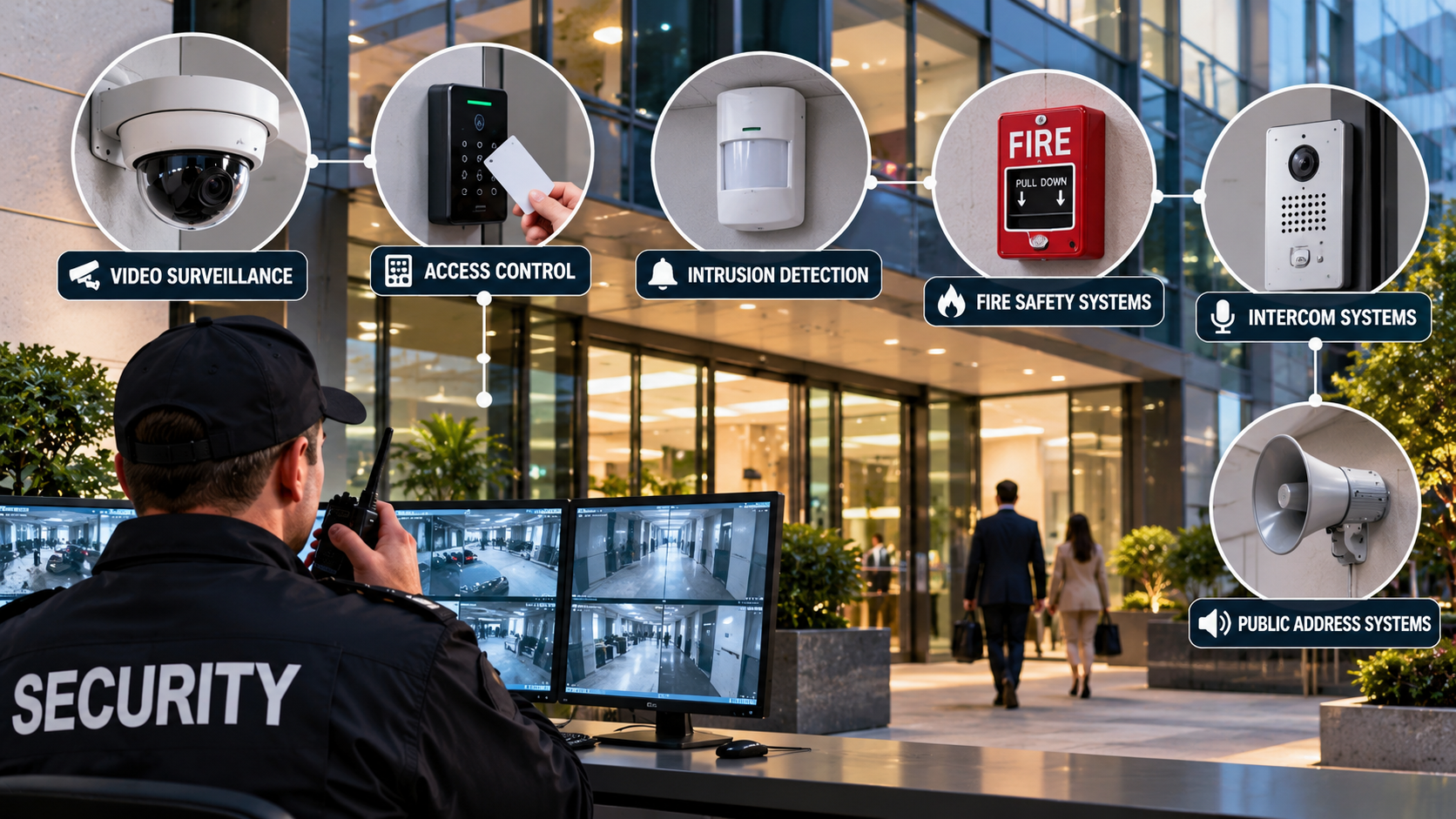
There are five types of security systems a business can put in place: intrusion detection, video surveillance, access control, monitoring, and staffed security. Each one answers a different question, and each one has a gap that only another layer closes.
Most businesses buy them one at a time, in response to something that happened. That is why the common result is three layers that overlap and two that are missing.
The five categories
1. Intrusion detection
Alarms, door and window contacts, motion sensors, glass break detectors.
The question it answers: has someone come in who should not have?
Where it stops: it tells you after entry, not before, and it tells you that something triggered rather than what. A system with a high false alarm rate stops being believed, which is a security failure even though the hardware works.
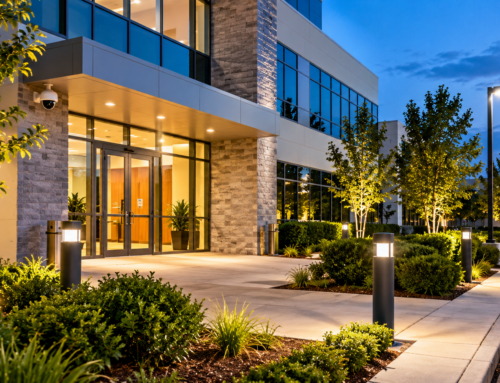
2. Video surveillance
Cameras, recording, and increasingly some form of analytics.
The question it answers: what happened, and can we prove it?
Where it stops: video is almost always reviewed after the fact. Unless somebody is watching a screen at the moment it matters, a camera is an evidence tool rather than a prevention tool. Placement matters more than count, because footage you cannot identify anyone from has little investigative value.
3. Access control
Credentials, readers, electronic locks, visitor management.
The question it answers: who is allowed in, and where can they go?
Where it stops: it controls credentials, not people. It cannot tell that two people walked through on one badge, and it cannot stop a credential that was never revoked. Most access control failures are process failures rather than technology failures.
4. Monitoring
A manned center receiving alarm and video signals, usually offsite.
The question it answers: who notices at three in the morning?
Where it stops: monitoring can verify and escalate, but it is remote. The response time is whoever it dispatches, not the center itself.
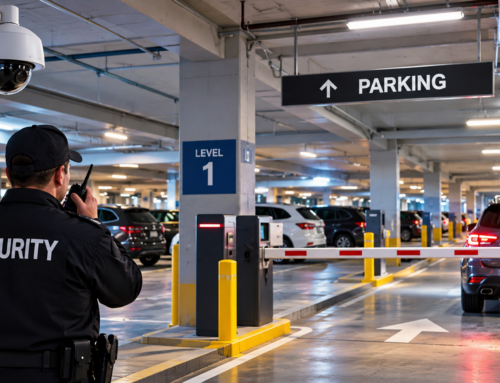
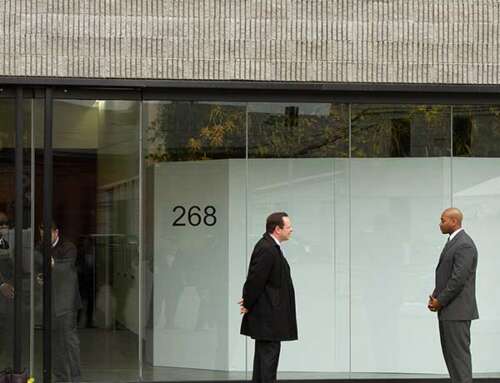
5. Staffed security
Officers on post, patrols, or a mix.
The question it answers: who decides and who intervenes?
Where it stops: a person covers one place at a time, and staffing is an ongoing cost in a way hardware is not. The case for staffing is judgment and response, not area coverage.
Compared
| System | Prevents | Detects | Records | Decides | Responds |
| Intrusion detection | Partly | Yes | Partly | No | No |
| Video surveillance | Partly | Sometimes | Yes | No | No |
| Access control | Yes | Partly | Yes | No | No |
| Monitoring | No | Yes | Yes | Partly | No |
| Staffed security | Yes | Yes | Partly | Yes | Yes |
The pattern in that table is the whole argument for layering. Only the last row has anything in the final two columns.
Which layer are you missing?
A short diagnostic, in the order worth asking.
Do you know who is in the building right now? If not, the gap is access control.
If something happened last Tuesday at 2am, could you find out what? If not, the gap is surveillance, or more likely surveillance placement.
If an alarm triggers at 3am, who hears it and what do they do? If the answer is that it calls a phone that might be on silent, the gap is monitoring.
If something is happening right now, who goes? If the answer is the police, eventually, the gap is staffed presence.
Does anyone review all of this together? If each system was bought separately and nobody has looked at them as one set, that is its own gap.
Most businesses can answer the first three. The fourth is where the honest answers get shorter.
How the layers fit together
The useful mental model is a sequence rather than a stack.
Access control decides who gets in. Intrusion detection notices when that is bypassed. Surveillance records what happened.
Monitoring makes sure someone notices out of hours. Staffed security is the only layer that can change the outcome while it is still happening.
Spending more on an earlier layer does not substitute for a later one. A better camera does not respond faster, and a second alarm panel does not make a decision.
Where staffing is the missing layer, the shape of it varies: a fixed post, a mobile patrol, or cover at specific hours only. Our security guard services, unarmed security guards and armed security guards pages set out how each is structured, and for a commercial property it usually forms part of a wider building security arrangement.
Two mistakes worth avoiding
Buying depth where you have breadth. Upgrading cameras when you have no access control is spending in the column you already occupy.
Treating a system as a decision maker. Analytics flag, they do not conclude. Every alert still ends with a person deciding whether it matters, and that person is either on your site, in a monitoring center, or nowhere.
If you are not sure which layer is thin, get in touch.
Frequently asked questions
What are the main types of business security systems?
Five: intrusion detection, video surveillance, access control, monitoring, and staffed security. Each answers a different question, and the first four cannot respond to anything on their own.
Do I need all five?
No. The point of the categories is to show which question you currently have no answer to. A small site with controlled access and a monitored alarm may be adequately covered without a staffed post.
What is the difference between monitoring and surveillance?
Surveillance is the cameras and the recording. Monitoring is a staffed center receiving those signals and acting on them. Cameras without monitoring produce evidence; cameras with monitoring can produce a response.
Which is cheaper, security systems or guards?
Hardware is weighted toward up-front spend, staffing toward ongoing spend. They are not substitutes, because only one of them can intervene, so the comparison is usually the wrong question.
Does access control replace the need for a front desk?
It replaces the credential check, not the judgment. A reader cannot tell that someone followed an authorized person through, decide whether a visitor is expected, or handle a situation that is not covered by a rule.