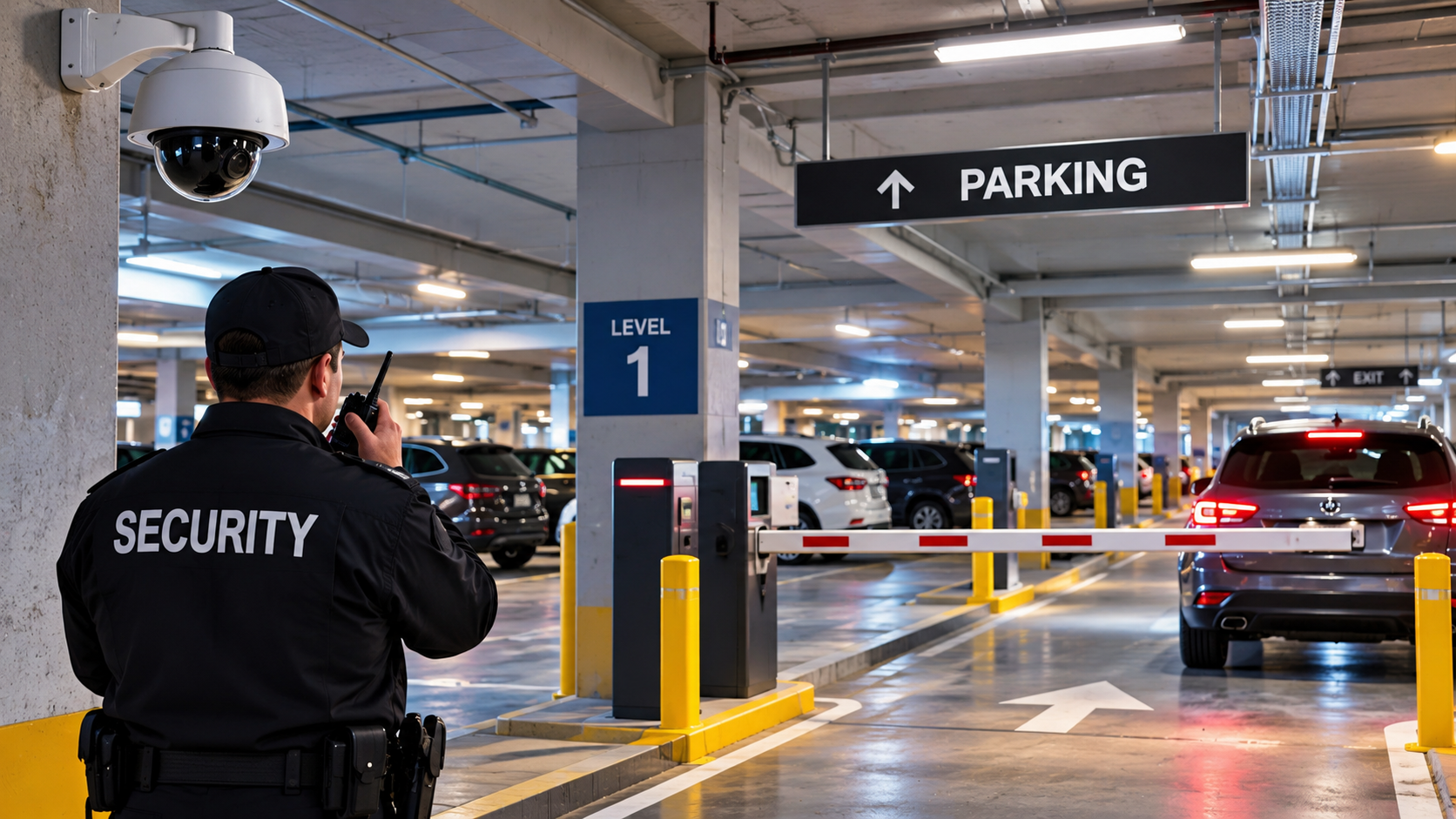
Parking lot security is harder than securing the building it serves, for a structural reason. A garage is a large, dimly lit space full of visual obstructions, where people arrive alone, carry things, and are predictably distracted at the moment they are most exposed.
Almost every parking problem traces back to one of six things. None of them require rebuilding the structure.
Why is parking harder to secure than the building?
Because a lobby is designed to be watched and a garage is designed to store cars. Everything that makes a garage efficient works against visibility.
Columns block sightlines. Low ceilings trap shadow. Ramps create blind transitions. Parked vehicles themselves are the obstruction, and the fuller the garage, the less of it anyone can see.
Then there is behavior. People walk to their car looking at a phone or carrying bags, usually at the end of a shift, often alone. A building lobby never has that combination.
The six places problems start
1. Lighting that fails quietly
A garage lit to specification on day one is rarely lit to specification in year three. Lamps fail one at a time, and nobody reports a single dark bay.
Walk the structure after dark on a schedule rather than waiting for a complaint. Pay attention to the edges and the corners, which is where failures matter and where surveys tend not to reach.
Uniformity matters as much as brightness. A very bright aisle next to a dark bay is worse than moderate light throughout, because eyes adapt to the bright part and the dark part becomes genuinely invisible.
2. Blind corners and pillar placement
Every column creates a hiding place roughly the width of the column. You cannot move them, but you can change what happens around them.
Convex mirrors at turns, paint treatments that lighten the structure, and removing anything stored against a column all help. So does deciding that certain bays nobody can see are staff bays rather than visitor bays.
3. Pedestrian routes nobody designed
In most garages the walking route was never designed. People take the shortest line to the lift, which often means walking in the vehicle lane, behind reversing cars, through the darkest part of the floor.
Mark a route. Light it better than the rest of the floor. Make it the obvious choice, and most people will use it.
4. Stairwells
Stairwells are the single most common weak point in a parking structure. They are enclosed, rarely used, often unlit, and they connect every level.
Glazing where the structure allows it, lighting that stays on rather than on a timer, and a policy on which stairs are open at which hours all change the picture. A stairwell that is permanently locked is a problem of a different kind, so this needs deciding rather than drifting.
5. Access that is open by default
Many garages are effectively public. Anyone can walk in from the street, and often drive in, with no point at which belonging is checked.
Where the garage serves a single building, a credential at the vehicle entrance and a controlled pedestrian door change who is in the structure at all. Where it is genuinely public, the answer is visibility and presence rather than access control.
6. Cameras pointed at cars
A camera covering a row of vehicles records a row of vehicles. It rarely produces an image you can identify a person from, because the distance is wrong and the light is poor.
Coverage at decision points, meaning entrances, exits, stair doors, lift lobbies and payment machines, is worth more than coverage of the floor area. The question to ask of any camera is which identification it would actually support.
What changes the picture
Ranked roughly by cost against effect.
| Fix | Cost | Effect |
| Relight and fix failures on a schedule | Low | High. The single biggest lever |
| Mark and light a pedestrian route | Low | High |
| Mirrors, paint and clearing stored items | Low | Moderate |
| Move cameras to decision points | Moderate | High for investigation |
| Control the pedestrian door | Moderate | High where the garage serves one building |
| Staffed presence at peak hours | Higher | Highest, and the only one that responds |
That last row is the one worth being honest about. Everything above it reduces opportunity. None of it intervenes.
A patrol or a staffed post is what turns a report into a response, and it is also the only measure that adapts when something unusual happens. How that coverage is structured sits on our security guard services and unarmed security guards pages, and parking usually forms part of a wider building security arrangement rather than a standalone one.
A walk to do this week
Go at the hour people leave in the dark. Not at midday.
Park in the furthest bay, then walk the route a visitor would take to the lift. Note every point where you cannot see ahead, every light that is out, and every place you would not want to be standing alone.
That walk produces a more useful list than any survey, because it is the actual experience the structure delivers. If the list has more than a few items on it, get in touch.
Frequently asked questions
What is the most common parking lot security problem?
Lighting that has degraded without anyone noticing. Lamps fail individually, nobody reports one dark bay, and over a couple of years the structure ends up well below the level it was designed to.
Do parking garages need security guards?
It depends on whether you need response or only deterrence. Lighting, layout and cameras reduce how often something happens and help afterwards. Only a person can intervene at the time.
Where should cameras go in a parking structure?
At decision points: vehicle entrances and exits, stair doors, lift lobbies and payment machines. Cameras aimed across open parking area rarely produce an identifiable image.
How do you secure a parking lot that is open to the public?
Access control is not available to you, so the levers are visibility and presence: lighting, sightlines, a marked pedestrian route, camera coverage at entry and exit points, and staffed presence at the hours that matter.
Are convex mirrors actually useful in a garage?
Yes, at blind turns and column corners. They are cheap, need no power and let a person see round an obstruction before they reach it. They do not replace lighting.