
A press junket is a single day, or a few days in a row, when a studio brings a film or show’s cast and director to one hotel or venue and runs back-to-back interviews with dozens of outlets. The reporters rotate. The talent stays put.
That is the whole idea behind it. Rather than sending four actors to thirty newsrooms, the studio brings thirty newsrooms to the four actors.
Why studios run them this way
A junket exists to solve a scheduling problem. A film’s publicity window is short, the cast is only available for a few days, and the studio needs coverage in a hundred places at once.
Running everything from one building compresses weeks of travel into a day. It also gives the studio control over the setting, the backdrop, the running order and the questions that get asked.
That control is the trade. Outlets get access to talent they would otherwise wait months for. In exchange they accept a short slot, a shared room and a schedule they do not set.
What a press junket day looks like
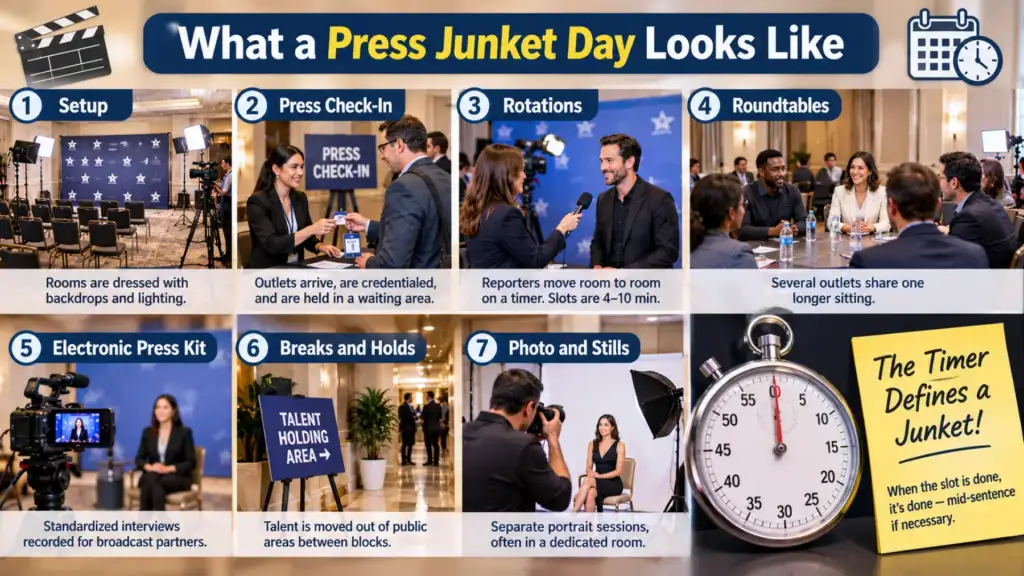
The shape is consistent across studios, even when the scale changes.
| Part of the day | What happens |
| Setup | Rooms are dressed with backdrops and lighting. Each outlet gets a set position. |
| Press check-in | Outlets arrive, are credentialed, and are held in a waiting area. |
| Rotations | Reporters move room to room on a timer. Slots are commonly four to ten minutes. |
| Roundtables | Several outlets share one longer sitting with one or two cast members. |
| Electronic press kit | Standardized interviews recorded for broadcast partners to cut as they like. |
| Breaks and holds | Talent is moved out of public areas between blocks. |
| Photo and stills | Separate portrait sessions, often in a dedicated room. |
The timer is the thing that defines a junket. A publicist stands at the door, and when the slot is done it is done, mid-sentence if necessary. Nobody is being rude. If one room runs four minutes long, every room after it runs four minutes long.
Who is in the room
More people than a finished interview suggests.
- Talent, usually one or two per room at a time
- A studio publicist running the clock and sitting in on the conversation
- A personal publicist for each principal cast member
- Camera and sound operators, either the outlet’s crew or a house crew
- Hair, makeup and wardrobe, working in the gaps between rotations
- A security or logistics lead, managing movement between rooms and floors
That last role is the one that is invisible when a junket runs well, and obvious the moment it does not.
The part nobody writes about
A junket concentrates recognizable people in one building, on a schedule, at an address that is often public by lunchtime. Everything that makes it efficient also makes it predictable.
The practical problems are rarely dramatic. Crowding in a hotel lobby. An elevator that strands talent on the wrong floor. A credentialed guest wandering into a hold room, a photographer at a service entrance, or a cast member who needs to leave twenty minutes earlier than the run sheet says.
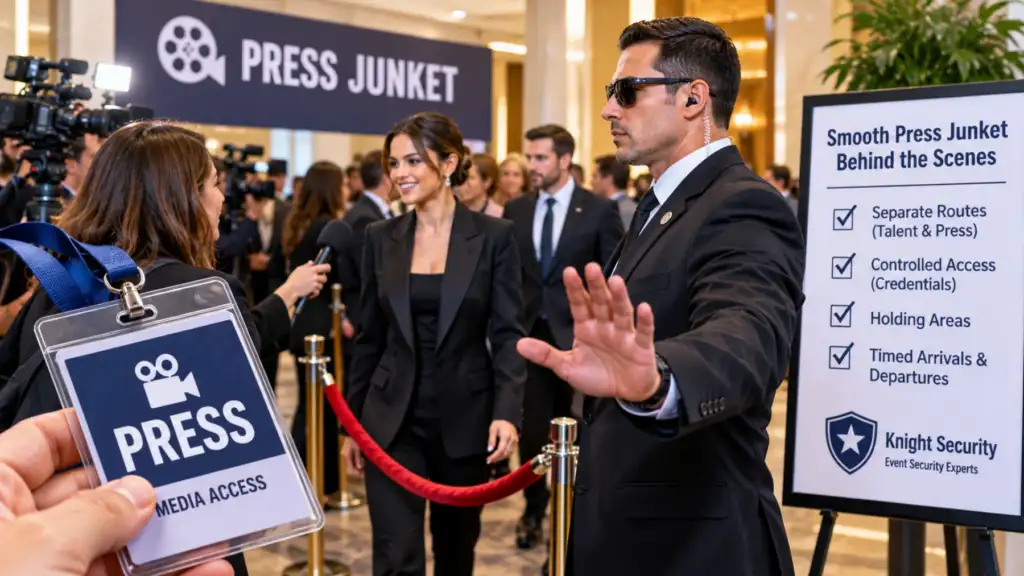
Most of that is solved before the day starts. Advance work establishes separate routes for talent and press, decides which doors are used and by whom, sets up holding areas away from public circulation, and agrees how arrivals and departures happen.
Credentialing carries a surprising amount of the load. Once everyone in the building is badged and the badge means something specific about where its holder may go, half of the day’s potential problems stop being problems.
Where a principal has their own detail, the junket is one stop on a longer day, and our guide to celebrity close protection covers how that side works. Knight Security provides press tour security covering this kind of work, including talk show appearances, red carpet and charity events , book signings and screenings.
Junket, press tour, red carpet: the difference
The three get used interchangeably and mean different things.
| Term | What it refers to |
| Press junket | Interviews run from one fixed location, with press rotating through |
| Press tour | A multi-city itinerary, moving talent between markets over days or weeks |
| Red carpet | A public arrivals line at a premiere or event, with photographers and fans present |
| Talk show appearance | A single booked slot at a broadcaster’s own studio |
A film’s publicity cycle normally uses all four. A junket for volume, a tour for geography, talk show appearances for reach, and red carpets for the images. A music release follows a similar pattern around a concert tour
Red carpets are the one part of the cycle that is open to the public, which makes them a different problem from a junket. We covered that in security for high-profile events.
Why the format has lasted
Virtual junkets became standard for a period and stayed in the mix afterward, usually as a tier for smaller or overseas outlets while the in-person day continues for the rest.
The reason the in-person format survived is simple. A remote slot produces a usable interview. A room produces the thing editors actually want, which is two people reacting to each other in the same space, with a backdrop that signals the film rather than someone’s spare bedroom.
If you are planning publicity around a release and want to talk through how the movement and access side of it should work, contact Knight Security and we can go through it with you.
Frequently asked questions
What does press junket mean?
It means a scheduled block of interviews run from a single location, where reporters from many outlets rotate through to speak with the same talent in turn. The studio or distributor organizes it and controls the running order.
How long is a press junket?
The interview slots are short, commonly four to ten minutes each, while roundtables run longer. For the talent the day itself is long, often a full working day of consecutive sessions with only short breaks.
Do journalists get paid to attend a junket?
No. Historically some studios covered travel and accommodation for outlets, which is the practice the word “junket” originally referred to, and many publications now decline that on policy grounds and pay their own way.
What is the difference between a press junket and a press tour?
A junket happens in one place and brings the press to the talent. A press tour moves the talent between cities over a longer period. A single release usually involves both.
Who organizes a press junket?
The studio or distributor’s publicity team, working with each cast member’s personal publicist, a venue, and production and logistics staff who handle the rooms, the recording setup and the movement of people through the building.