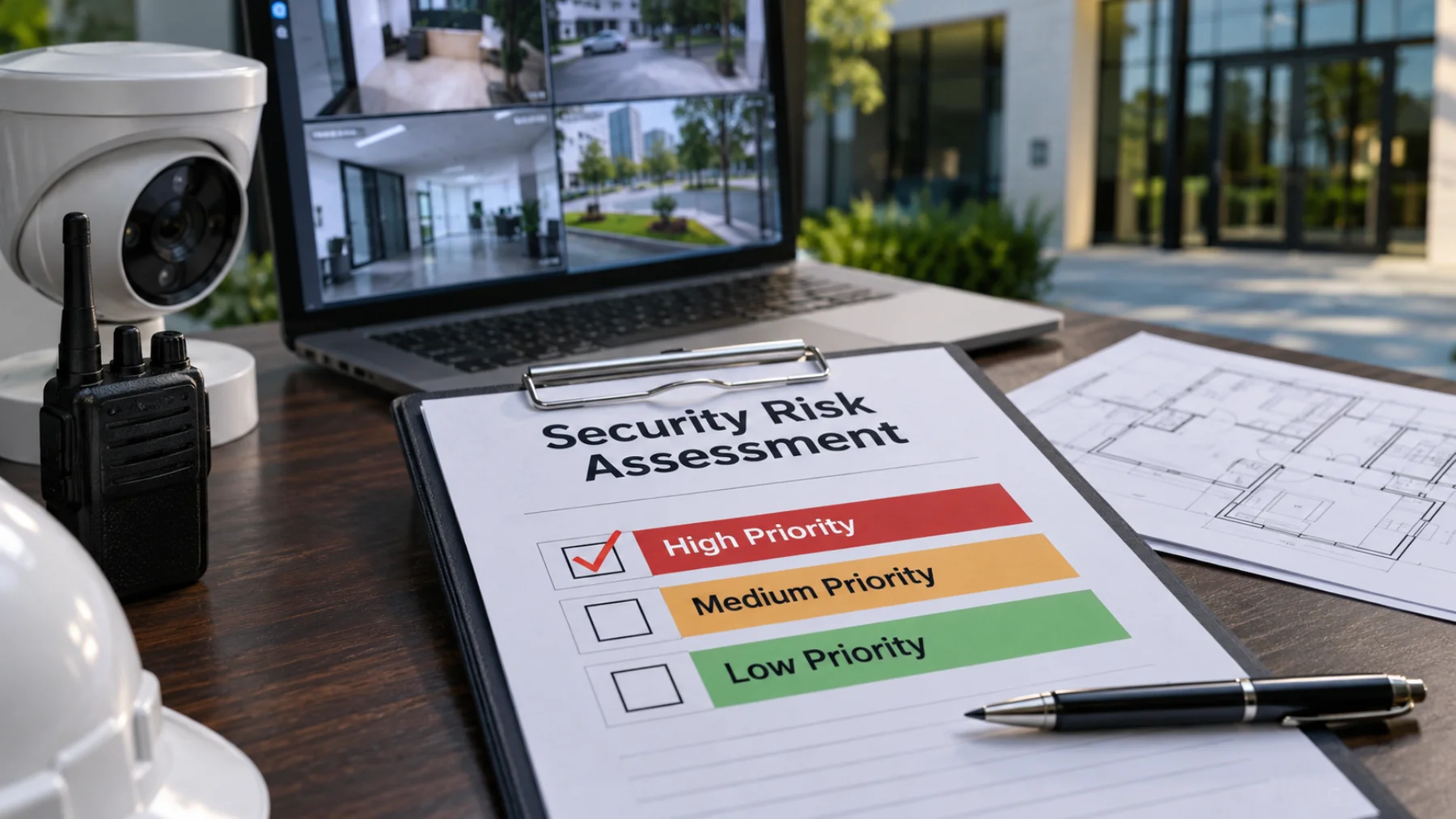
A physical security risk assessment is a structured look at a building, site or operation that ends in one specific deliverable: a prioritized list of threats, vulnerabilities and recommendations. Not a report that says security could be better. A ranked list of what is actually exposed, how badly, and what to do about it first.
The ranking is the whole point. Every building has more vulnerabilities than budget, so the output has to tell you which three to fix this quarter and which eleven can wait.
What an assessment is not
Three terms get used interchangeably and mean different things, which is why people end up buying something other than what they needed.
| Term | What it looks at |
| Threat assessment | What or who might cause harm, and how credible and capable that is |
| Vulnerability assessment | Where you are weak, regardless of whether anyone is currently exploiting it |
| Risk assessment | Threat and vulnerability combined with likelihood and consequence, then ranked |
| Security audit | Whether you are complying with a standard, policy or contract you already have |
Risk is the one that produces decisions, because it is the only one that weighs a weakness against how likely and how damaging its exploitation would be. A propped fire door and an unguarded loading dock are both vulnerabilities. They are not the same risk.
Worth noting that a search for “threat assessment” mostly returns cybersecurity material. The two disciplines share vocabulary and almost nothing else. This is about the physical environment: doors, people, sightlines and movement.
The physical security risk assessment process
Six stages, in order. Skipping any of them is what produces a report nobody acts on.
- Define the scope and identify what you are protecting. People first, then property, then operations and information. A building that would survive a theft but not a two-day shutdown has a different risk profile than one where the reverse is true.
- Identify credible threats. Based on what the location, the business and the neighborhood actually present, not a generic list. Burglary, internal theft, trespass, vandalism, workplace violence, protest activity, unauthorized access for a later purpose, and in some settings targeted interest in a specific person.
- Find the vulnerabilities. This is the walkthrough, and it is the part that cannot be done from a desk.
- Assess likelihood and consequence. For each pairing of a threat and a vulnerability: how likely is it here, and what happens if it occurs. A low-likelihood, severe-consequence finding often outranks a frequent nuisance.
- Prioritize and recommend. Rank the findings, then attach a countermeasure to each one, with the cheap and immediate separated from the capital projects.
- Document and set a review date. A risk assessment is accurate on the day it is written. It starts aging the moment the building changes.
What the walkthrough actually covers
The site visit is where an assessment earns its value, and the findings are usually mundane rather than dramatic.
- The approach and perimeter. How someone gets to the building before they are anyone’s problem. Fence lines, landscaping, parking, sightlines.
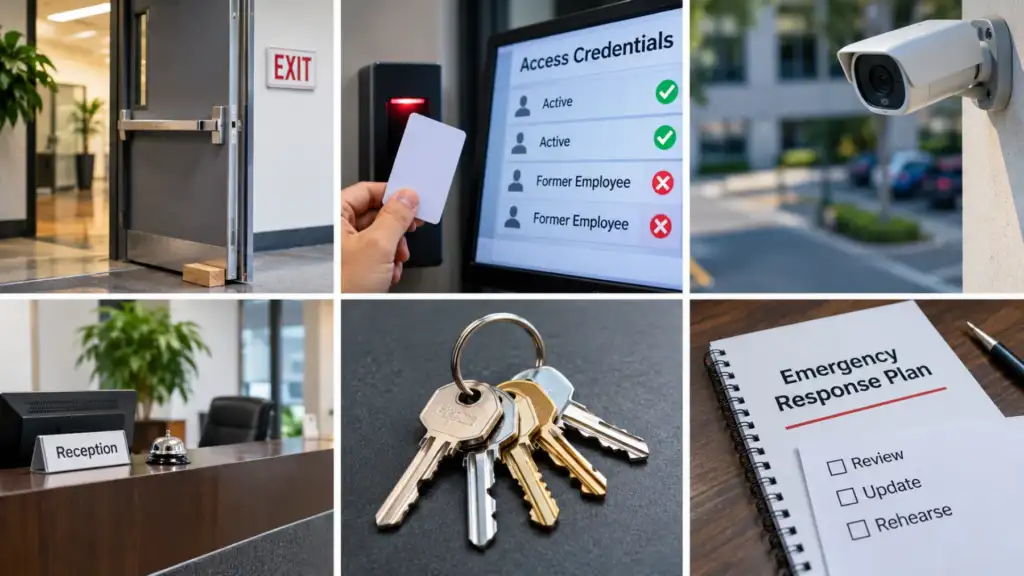
- Entry points. Every door, not the ones on the drawings. Service entrances, loading docks, roof access, fire exits, the door the smokers use.
- Access control. Whether credentials are issued, revoked, audited, and whether tailgating is normal behavior in the lobby.
- Lighting. At night, which is the only time this can be assessed. Dark approaches, dead corners, lights that are out.
- Surveillance. Camera coverage against actual blind spots, whether recordings are retrievable, how long they are kept, and whether anyone watches them.
- The lobby and reception. Where visitors are stopped, whether they are stopped, and what happens to someone who walks past.
- Interior compartmentation. Whether reaching the floor means reaching every room on it.
- Key and credential control. Who holds what, how many copies exist, what happens when someone leaves.
- Procedures as practiced. The gap between what the policy says and what staff actually do at 4pm on a Friday.
- Emergency readiness. Whether the evacuation and emergency action plans exist, are current, and are known to the people who would have to run them.
That last category is where many assessments find the largest exposure, because it costs nothing to leave a plan out of date and nothing goes wrong until something does.
The findings that recur
Across commercial buildings, the same handful come up repeatedly.
Doors that are secure on paper and propped in practice. Credentials that were never revoked for people who left. Cameras pointed at where an incident happened once rather than where the current blind spots are. A lobby where confidence gets someone past reception. Keys with no record of how many exist. And an emergency plan written to satisfy a requirement, filed, and never rehearsed.
None of those need a large budget. They need somebody to have looked, written it down, and assigned it to a person with a date.
Likelihood and consequence, kept simple
You do not need a complicated scoring model. A defensible assessment can use a simple scale as long as it is applied consistently and the reasoning is written down.
| Low consequence | Moderate consequence | Severe consequence | |
| Likely | Fix in routine operations | Fix now | Fix now, escalate |
| Possible | Monitor | Plan and schedule | Fix now |
| Unlikely | Accept and record | Monitor | Plan and schedule |
What makes this work is the written reasoning behind each placement. A finding ranked low is a decision the organization has made, and recording why is what distinguishes an accepted risk from an overlooked one.
How often to do it again
Annually is a reasonable default for a stable building. Sooner when something material changes.
A tenant moves in or out. The use of the space changes. An incident happens, there or nearby. A renovation alters circulation or entry points. Security staffing or the contract changes. Or a specific threat emerges that did not exist before.
The trigger is change, not the calendar. A building that was assessed in March and reconfigured in June has an assessment describing a building that no longer exists.
Turning it into something that happens
The most common failure is not a bad assessment. It is a good one that nobody actions.
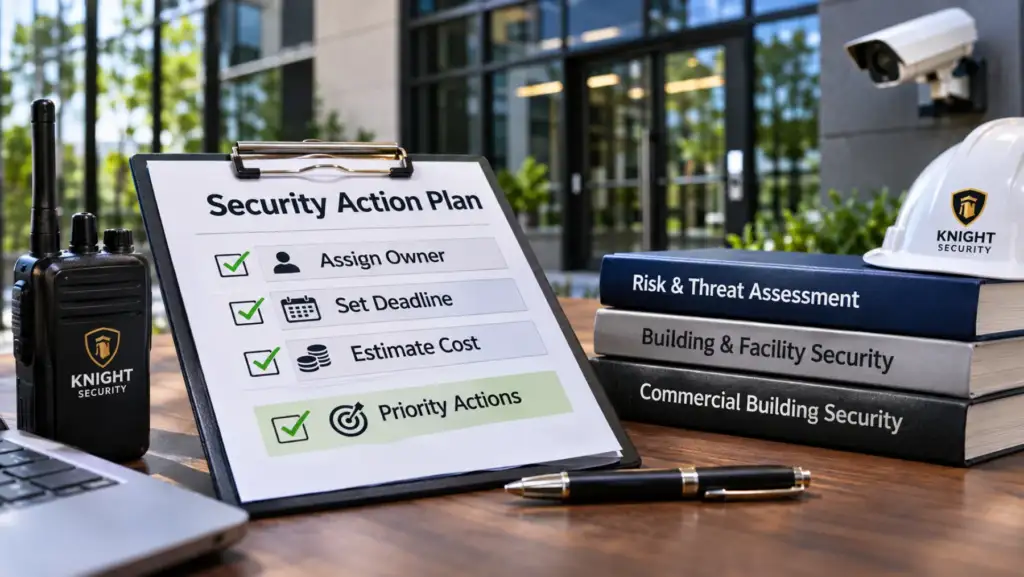
What prevents it: every recommendation has one named owner, a date, and a cost category. The immediate and free items get done in the first week, which builds the credibility to fund the rest. And the list gets reviewed on a schedule rather than when someone remembers it.
Knight Security provides risk and threat assessment as part of our additional security services, producing a prioritized list of threats, vulnerabilities and recommendations, and we work from that into building and facility security and commercial building security where it is needed.
If you want the design side of this, crime prevention through environmental design covers how layout, lighting and sightlines reduce risk before any staffing decision, and our building security tips for commercial properties covers the practical measures. To arrange an assessment of your building, contact Knight Security
Frequently asked questions
What is a physical security risk assessment?
A structured review of a building, site or operation that identifies credible threats and existing vulnerabilities, weighs each by likelihood and consequence, and produces a prioritized list of recommendations.
What is the difference between a threat assessment and a risk assessment?
A threat assessment examines what or who might cause harm and how capable they are. A risk assessment combines that with your vulnerabilities, the likelihood of occurrence and the consequence, then ranks the results so they can be acted on.
How long does a security risk assessment take?
It depends on the size and complexity of the site. The walkthrough is usually a matter of days rather than weeks, and the time is spent on access points, procedures as actually practiced, and a night visit for lighting.
How often should a building be reassessed?
Annually for a stable building, and sooner after any material change: a new tenant, a change of use, a renovation that alters entry points or circulation, an incident, or a change in security staffing.
Who should carry out the assessment?
Someone independent of the people who run security day to day, because the value lies in seeing what has stopped being visible to the people walking past it every day. Our guide to hiring a building security consultant covers how to choose one.